10 Common Wedding Planning Mistakes—and How to Avoid Them
Many planning problems aren’t caused by a lack of ideas, but by getting the order wrong, keeping parallel lists, and leaving responsibilities unclear. These ten mistakes are easy to avoid early on.
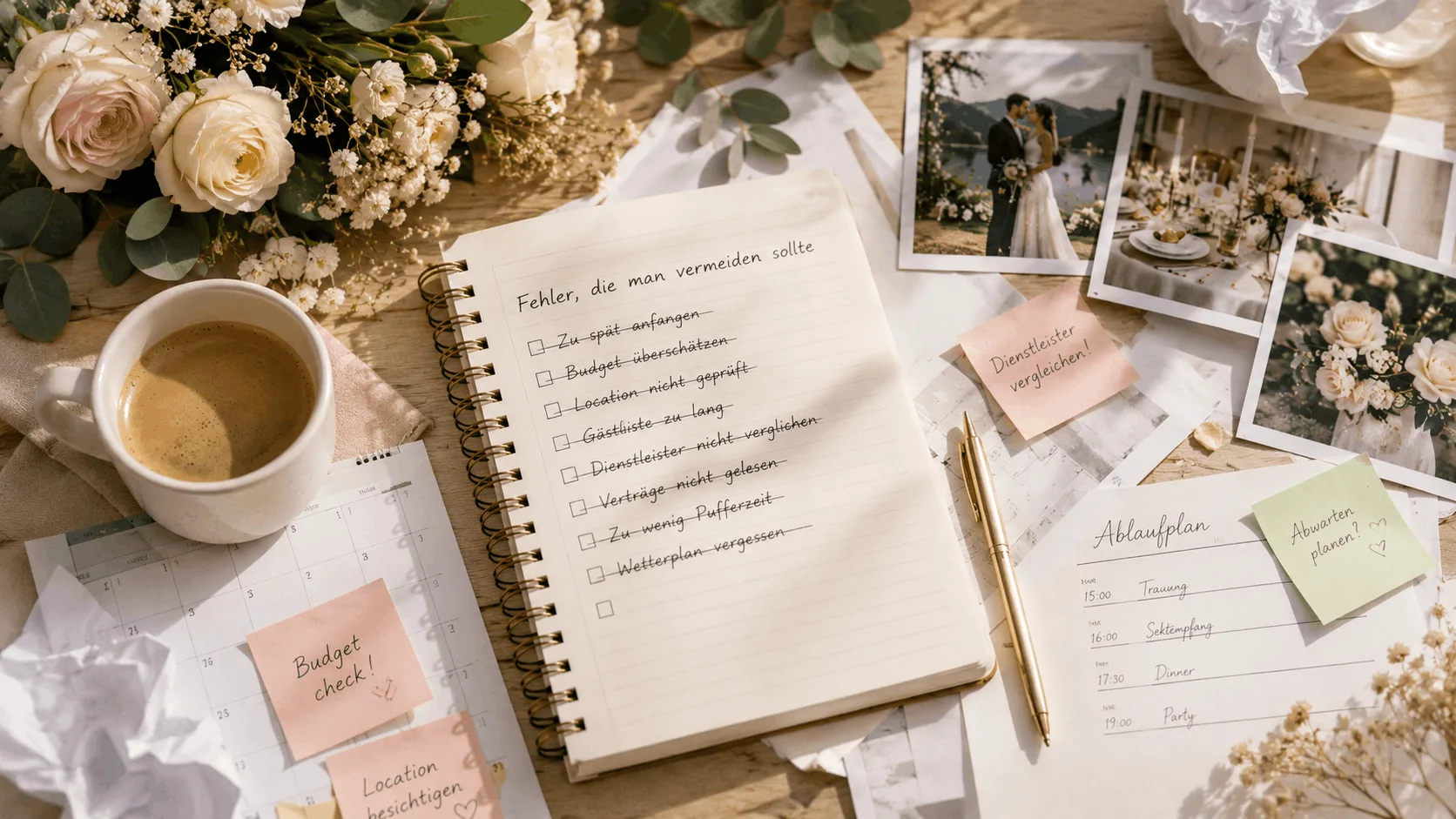
Wedding planning rarely gets difficult because couples don’t have enough ideas.
The opposite is more often true.
There are too many options, too many decisions to make, and information scattered across too many places.
You can avoid many common problems by planning not more, but more clearly.
Here are ten mistakes that often cause unnecessary stress.
Mistake 1: Starting with the details before setting the framework
Colors, flowers, stationery, and decorations are fun to think about.
But they shouldn’t be your first decisions.
If your budget, guest count, date, and venue are still up in the air, early decisions about the details may no longer work later on.
A better approach
Start by agreeing on:
- your budget range
- an approximate guest count
- the date
- the venue
- your priorities
After that, it’s much easier to make decisions about the style.
Mistake 2: Leaving the guest list open for too long
Your guest count affects:
- the venue
- catering
- your budget
- invitations
- the seating plan
Even so, some couples keep their guest list open right up until late in the planning process.
That creates a chain reaction of problems.
A better approach
Start with a generous draft, then agree on a target number together.
Your final list can still change. But you need a realistic starting point for planning early on.
Mistake 3: Tracking only the amount you planned to spend
Your budget isn’t up to date if it only shows what you originally planned to spend.
Once you start receiving quotes and making bookings, you need to track several figures.
A better approach
Keep track of:
- planned costs
- committed costs
- amounts paid
- amounts still due
This makes it easier to spot early on when a category is costing more than expected.
Mistake 4: Collecting too many quotes without a system
Having more options can feel reassuring.
But if you contact ten vendors in every category, you can quickly end up with:
- lots of emails
- different services
- different deadlines
- follow-up questions
- pressure to make a decision
A better approach
Make a good shortlist, then compare vendors using the same criteria.
Keep track of open questions alongside the relevant vendor’s details.
Mistake 5: Scattering information across too many places
Some of your plans are in messaging apps, others are in emails, one list is in a spreadsheet, and important notes are on paper.
Before long, no one knows which version is up to date.
A better approach
Choose one central place for each area of planning.
For example:
- tasks in one place
- the guest list in one place
- the budget in one place
- vendor information in one place
- the day-of schedule in one current version
Links and documents can still be stored in different places. But the key information should always be easy to find in one central spot.
Mistake 6: Not building in any buffer time
Schedules often look perfect on paper.
The ceremony ends at 2 p.m. The reception starts at 2:20 p.m. Dinner is at 5:30 p.m.
In reality, these things take longer than you think:
- congratulations
- getting from place to place
- gathering groups
- photos
- spontaneous conversations
A better approach
Build buffer time into parts of the schedule where delays can be absorbed.
A good schedule isn’t the tightest one—it’s one that can handle small delays.
Mistake 7: Wanting to make every decision right away
New ideas keep coming up throughout the planning process.
If you act on every bit of inspiration right away—by deciding, buying, or booking—you can quickly make your wedding feel disjointed and expensive.
A better approach
Keep an idea parking lot.
Write down new ideas first, then come back to them later and ask:
- Does this fit our priorities?
- Does it fit our budget?
- Do we really need it?
- Who will take care of it?
Many ideas stop feeling urgent on their own after a few days.
Mistake 8: Keeping tasks in your head
“We still need to … at some point.”
That sentence is a source of stress.
Unfinished tasks without a deadline or someone responsible for them keep taking up mental space.
A better approach
Every real task should have at least:
- a clear description
- someone responsible
- a sensible deadline
Turn “look at photographers” into:
Choose three photographers who seem like a good fit and contact them by Sunday—Alex.
That’s something you can act on.
Mistake 9: Trying to coordinate everything yourselves on the wedding day
Many couples plan carefully for months, then still make themselves the main point of contact on their wedding day.
Then questions come their way:
- Where should the cake go?
- When does the speech start?
- Where’s the gift?
- The DJ needs access—who has the key?
A better approach
Assign people to be responsible.
At least one person should know the current timeline and have the key contacts.
Vendors should know who to contact with practical questions.
You’re allowed to be guests at your own wedding.
Mistake 10: Comparing your plans with other weddings
Social media offers an endless stream of ideas.
It’s easy to start feeling that a wedding “has to have” certain things.
A photo booth, candy bar, elaborate signage, special decorations, activities, wedding favors—they can all be lovely.
None of them are automatically essential.
A better approach
For every bigger idea, ask:
Would we miss anything if we didn’t do this?
If not, you can let it go.
Your wedding doesn’t need to include as many elements as possible.
It should feel like the two of you.
Bonus mistake: Waiting too long to talk about your priorities
Many disagreements about budget or style are really disagreements about priorities.
One person wants a large guest list; the other wants a special venue. One person cares most about photography; the other about music.
If those wishes only come to light when you’re looking at specific quotes, every decision can start to feel like a tug-of-war.
A better approach
Each of you should name your three most important priorities early on.
Then look for a plan that brings both sets of priorities together as well as possible.
A simple system to prevent chaos
If you’re feeling overwhelmed, sort everything into five areas.
Tasks
What actually needs to be done?
Decisions
What choices are still open?
Budget
What are the financial implications?
People
Who needs to be informed or involved?
Dates
What deadline or fixed date is involved?
Almost every planning problem can be assigned to at least one of these areas.
That makes it easier to get a handle on.
Not every open item is urgent
Another common source of stress is feeling as if every unfinished item is equally important.
Sort them into:
- urgent and important
- important, but for later
- optional
- can be dropped
Choosing a venue should be a higher priority early on than choosing wedding favors.
Getting the order right reduces stress more than adding ever more items to your to-do list.
What if you’re already in the middle of planning chaos?
You don’t have to start over.
Set aside an evening to gather all your open items in one place.
Then:
- delete duplicate tasks
- remove completed items
- sort tasks into categories
- add deadlines
- assign responsibilities
- mark only the next few steps as active
After that, you won’t be working on everything at once again.
You’ll be working on the next sensible step.
Conclusion: Fewer loose ends, more clarity
A relaxed wedding-planning process doesn’t mean nothing ever goes wrong.
It means you know where the information is, what decision comes next, and who’s taking care of it.
Above all, avoid:
- details before the basics
- parallel lists
- unclear budgets
- too many open quotes
- no buffer time
- tasks without someone responsible
That way, wedding planning won’t become a second full-time job—it’ll stay manageable, one step at a time.