
Creating Your Wedding Guest List: How to Make Clear Decisions
Your guest list affects your budget, venue and the atmosphere of your wedding. With a simple system, you can decide together who to invite, how to organise households and how to keep track of RSVPs.
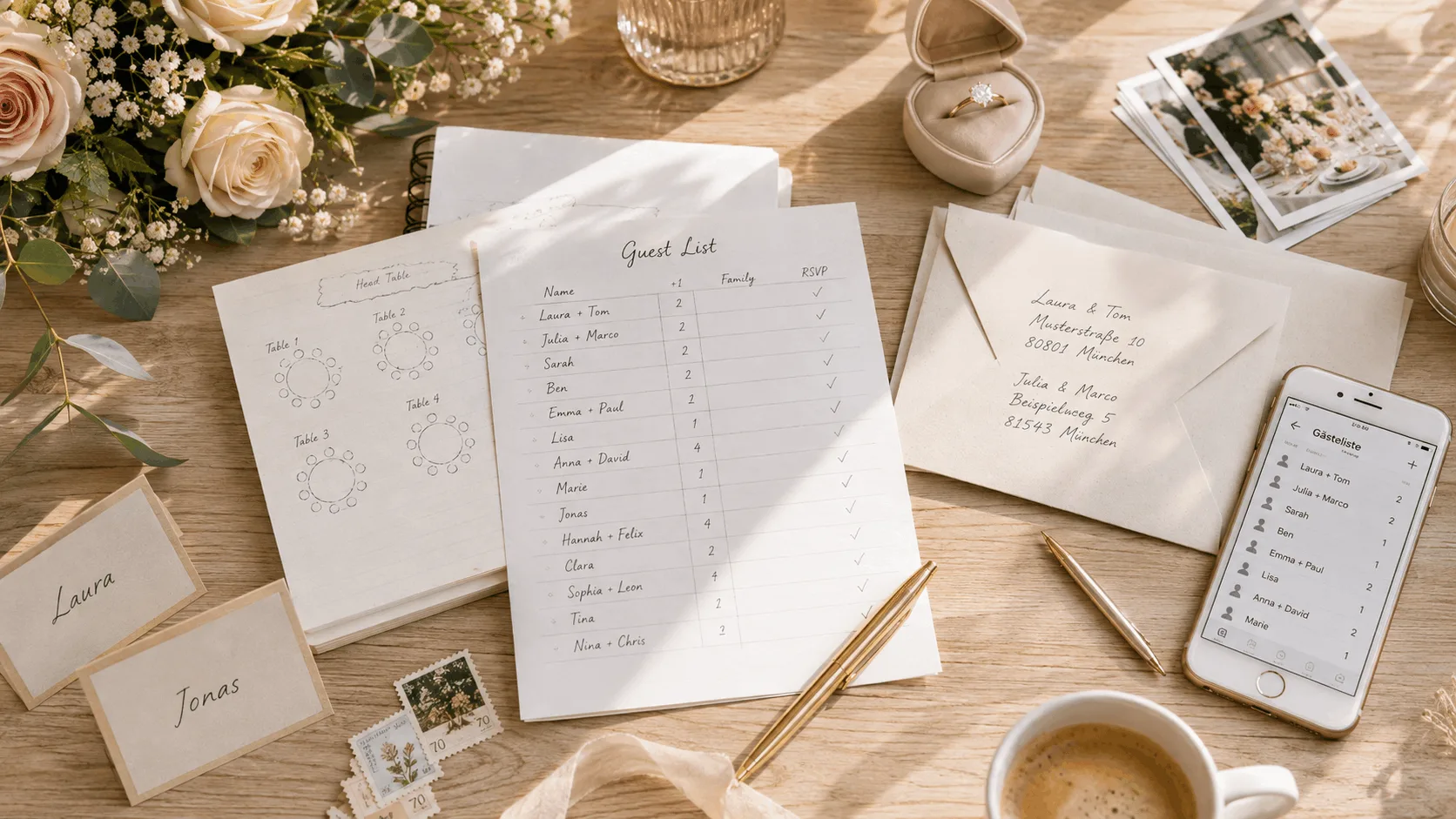
At first, few parts of wedding planning seem as simple as putting together a guest list. Write down some names – done.
In practice, though, a lot depends on it: the size of your venue, your budget, the number of invitations, the seating plan and, not least, the atmosphere of your celebration.
That’s why a good guest list isn’t created in a single sitting. It evolves from a rough list into a final list with clear invitation groups, then into an up-to-date overview of acceptances and declines.
Start separately – then decide together
For your first drafts, it can help if you each make a list of names independently.
Start by writing down everyone who immediately comes to mind as important to you.
Then combine your two lists.
This way, your first draft won’t already be shaped by compromises. You’ll also quickly see where your lists overlap and where they differ.
Then sort the names into groups together.
For example:
- essential to us
- we’d really love to have them there
- invite depending on space and budget
- probably not
These categories are just a planning tool. You don’t need to show them to anyone.
Work out your target guest count first
Before discussing individual borderline cases, you should have a rough idea of how many people your wedding can accommodate.
Three limits are important:
The venue
How many people can realistically fit in the space – not just in terms of capacity, but in a way that allows you to celebrate as you want?
The budget
More guests mean extra costs in many areas.
Your preference
You may be able to invite 150 people, but choose to celebrate with just 60.
The maximum number of guests isn’t automatically the right number for you.
Think in invitation groups
A guest list is easier to manage when you think in terms of groups rather than just individuals.
Typical groups include:
- couples
- families with children
- housemates
- single guests with a plus-one
- households
This will make invitations and RSVPs easier to manage later.
For example, if a couple receives a joint invitation, you should still list each person separately in your internal guest list. That way, your guest count stays accurate.
Partners: Agree on a rule together
Plus-ones can quickly lead to imbalances.
A clear rule can help.
For example, you could decide that:
- people in established relationships are invited together
- guests you don’t know well can bring someone only by prior arrangement
- single guests don’t automatically get a plus-one
It’s up to you to decide which rule works best. The main thing is not to renegotiate it for every guest.
Children: Decide early and communicate clearly
There’s no one-size-fits-all answer when it comes to children, either.
You can:
- invite all children
- invite only children in your immediate family
- plan an adults-only celebration
- make different arrangements for different parts of the day
Consider the type of wedding you’re planning, the venue and your guests’ circumstances.
Once you’ve made your decision, communicate it kindly and clearly. Vague wording is more likely to lead to awkward questions later than a clear invitation.
Family and outside expectations
The guest list is one area where family wishes can become especially prominent.
Perhaps you’re expected to invite relatives you barely know. Maybe your parents want to add friends or business contacts.
A guiding principle can help here:
Your guest list needs to work for you as a couple.
If other people are contributing financially, their wishes can naturally be part of an open conversation. Even so, you should first agree between yourselves on the boundaries you want to set.
Discuss any conflicts together first, then present a united front to others.
Who do we have to invite “out of politeness”?
A useful question to ask yourselves is:
Would we really miss this person on our wedding day?
If the answer is clearly no, it’s worth taking a closer look.
Other questions to consider:
- Do we have a genuine relationship with this person now?
- Would we invite them even without family or work-related expectations?
- Do we meet or talk outside of major occasions?
- Does inviting them feel exciting or more like an obligation?
Not every former friend or distant acquaintance needs to be part of your wedding.
Colleagues and larger groups of friends
Workplaces and wider friendship groups can be tricky when you only want to invite some people.
There are several sensible approaches:
- invite only close friends outside of work
- invite a clearly defined team in full
- don’t invite colleagues at all
- invite people to the ceremony but not the reception, or vice versa
Where possible, avoid arbitrary cut-offs that are difficult to explain later.
You don’t have to justify your guest list publicly. Having a consistent rule can make the decision easier for you, though.
What information do you really need?
You need less personal information for planning than you might think.
Useful details may include:
- name
- household or invitation group
- invitation status
- acceptance or decline
- plus-one
- number of children
- meal choice or preference
- planning note
Avoid collecting unnecessary sensitive information. For general planning, a meal choice or preference is usually enough, for example. Medical diagnoses or detailed health information don’t belong on a standard guest list.
Keep invitation status and RSVP separate
“Invitation sent” and “guest is coming” are two different pieces of information.
A simple status system could look like this:
Invitation
- planned
- sent
Response
- pending
- accepted
- declined
This makes it easy to see whether someone hasn’t received an invitation yet or simply hasn’t replied.
Set a clear RSVP deadline
An RSVP deadline doesn’t just help you.
It also lets your guests know when you need their decision.
Leave enough time between the RSVP deadline and the wedding. You’ll still need time to finalise:
- the final guest count
- catering
- the seating plan
- place cards
- any accommodation
- information for your vendors
If you’re still waiting for responses, don’t leave it until just before the wedding. Follow up politely once the deadline has passed.
Acceptances and declines affect your plans
A decline is more than just a status update for planning purposes.
It can affect:
- table arrangements
- household groups
- accommodation
- transport
- meal numbers
That’s why your guest list should always be the up-to-date reference for your next planning steps.
Avoid keeping parallel versions in different files. Having one central list significantly reduces mistakes.
What should you do with a waitlist?
If your preferred guest list is larger than the number of people you can invite, it may help to create a second priority group for your own planning.
Use discretion, though.
Send invitations in good time and avoid situations where it’s obvious that someone has been invited at the last minute after another guest declined.
A traditional waitlist isn’t right for every wedding. Sometimes a smaller, clearly defined guest list is the more comfortable option.
Leave the seating plan until later
Don’t finalise your seating plan too early.
If you’re still waiting on lots of responses, you’ll only create extra work for yourselves.
You can start thinking about:
- which groups get along well
- which people shouldn’t sit right next to each other
- whether children need their own area
- which guests may need support or shorter routes
But you should only finalise the table arrangements once your guest count is settled.
A good guest list is a decision you make together
The hardest cases are rarely technical.
They often involve feelings, family, friendships and expectations.
So set aside dedicated time to work on your guest list rather than trying to decide between other tasks.
If you disagree about someone, don’t immediately try to convince each other.
Instead, ask:
- Why is this person important to me?
- What concerns me about inviting or not inviting them?
- Is there a rule we can apply to similar situations, too?
This can turn a personal disagreement into a decision you make together.
Conclusion: Your guest list is the foundation for many next steps
A good guest list is more than a collection of names.
It brings together:
- guest count
- budget
- venue
- invitations
- RSVPs
- seating plan
Start with a generous first draft, then define your limits and keep the final list in one central place.
The clearer your guest list is, the easier many of the decisions that follow will be.