
Wedding Planning: The 12-Month Checklist
What should you do a year before the wedding, and what can wait? This checklist guides you through the most important decisions month by month and helps you organize tasks, budget, guests and vendors.
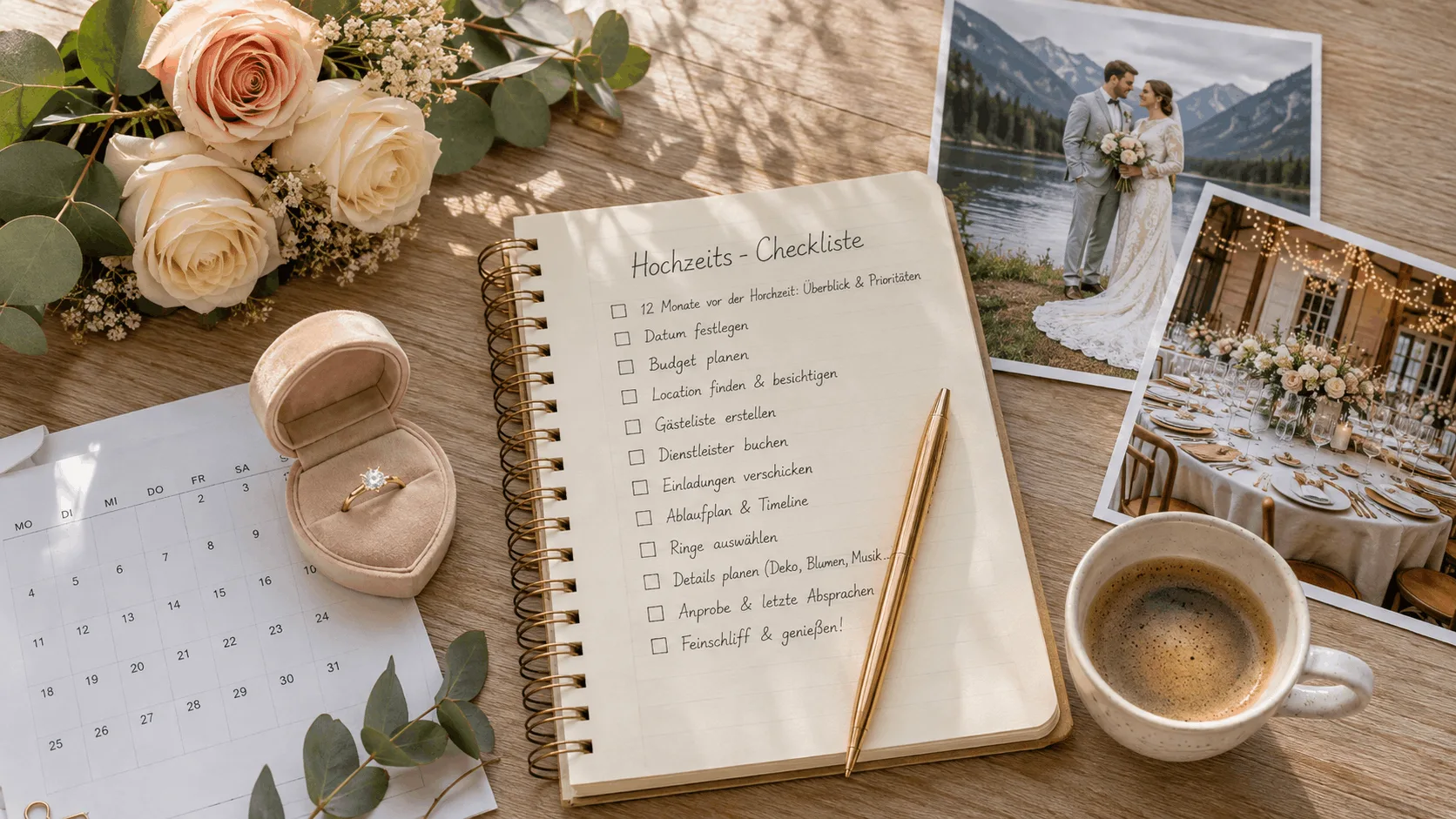
Planning a wedding doesn’t mean you have to get something done every day for twelve months. What matters is tackling the right things in the right order.
Sort out the big-picture details early, and many of the decisions that follow will feel much more manageable. Your budget, guest count, date and venue affect almost everything else. Details such as wedding favors or the final seating plan can wait.
This 12-month checklist will help you stay on top of everything. It isn’t a rigid set of rules: if your wedding is just six months away or you have a year and a half to plan, you can condense or spread out the steps accordingly.
12 months before: Set the framework
At this stage, it’s not about napkin colors or individual parts of the schedule. First, you need to agree on the big picture.
Talk through these questions together:
- What kind of wedding do we want?
- When would we like to get married?
- Roughly how big should the celebration be?
- Which guests are must-haves for us?
- What total budget feels realistic?
- Which three things matter most to us?
That last question can be a huge help later on. Perhaps great food, a special venue and photography are your top priorities. Another couple might care more about music, décor or a large guest list.
Once you know your priorities, you won’t have to revisit the fundamentals with every decision.
Budget and guest count first, details later
Your initial guest count doesn’t have to be exact. A realistic estimate is enough to get started.
A small gathering and a large wedding differ considerably in terms of venue, catering, equipment and budget. That’s why it’s worth putting together a rough guest list early on.
You don’t need a perfect budget breakdown yet, either. Start by setting a maximum and include a contingency for costs you can’t see coming yet.
A good wedding budget doesn’t just answer “How much will the wedding cost?” It also answers “What do we want to spend our money on?”
11 to 10 months before: Book your date and venue
Once you have a rough idea of your plans, guest count and budget, you can start looking for the right venue.
Don’t compare venues based on photos and prices alone. Check the practical details, too:
- Is the capacity right for our guest count?
- What services are included in the price?
- Does the venue provide catering, or can we choose our own caterer?
- How late can the celebration go on?
- Are there places to stay nearby?
- How will guests get to the venue and back home?
- What rules apply to music, décor and outside vendors?
- What are the deposit and cancellation terms?
Once you’ve chosen a venue, make sure your date is confirmed.
You can also work out how the ceremony will be organized and what dates you need to book for it.
9 months before: Contact your key vendors
You don’t need to book every vendor a year in advance. However, some have limited availability on each wedding day.
It’s worth contacting these vendors early:
- Photographers and videographers
- DJ or live music
- Independent wedding celebrants
- Caterer, if the venue doesn’t provide catering
- Wedding planner or ceremony coordinator, if you’d like one
Don’t compare quotes by the final price alone. Check exactly what’s included.
For photographers, for example, the number of hours, number of edited photos, travel costs and usage rights may vary. With DJs, equipment, lighting, setup and breakdown, or extra hours can affect the price.
Keep quotes and decisions in one place. This way, information won’t get scattered across emails, messaging apps and scraps of paper.
8 months before: Finalize your guest list
Now it’s time to turn your rough guest count into an actual guest list.
Group guests by household or invitation party. This will make invitations, RSVPs and seating arrangements easier later on.
For each person or household, you could keep track of:
- Name
- Invitation planned or sent
- Accepts or declines
- Plus-one
- Children
- Relevant practical notes
Only collect information you actually need for planning. Medical details or diagnoses don’t belong on a general wedding guest list.
If your guests are traveling from different areas, now is also a good time to look into hotels, transport options and possible room blocks.
7 months before: Save the dates and guest communication
For many weddings, it makes sense to let guests know the date well in advance—especially if travel, holiday periods or lots of out-of-town guests are involved.
Your save-the-date doesn’t need to include every detail. For now, the essentials are:
- Your names
- Wedding date
- Approximate location or region
- A note that the invitation will follow
You can also start thinking about how you’d like to share information in one central place later on.
A wedding website, for example, can bring together the address, schedule, accommodation, travel information and frequently asked questions. That way, you won’t have to send the same information to everyone individually.
6 months before: Outfits, styling and other vendors
About six months out, you can start focusing more on the look and feel of the day.
Depending on your wedding, this may include:
- Wedding outfits
- Flowers
- Décor
- Cake or dessert
- Hair and makeup
- Wedding stationery
- Wedding rings
- Transport
- Childcare
- Special activities or entertainment
This is when it can be easy to find yourself making lots of separate decisions at once.
So start by agreeing on an overall direction: What kind of atmosphere do you want for your wedding? Elegant, relaxed, modern, natural, urban or classic?
A clear vision makes individual choices easier and helps you avoid buying things just because you like them on their own.
5 months before: Prepare your invitations
By now, you should have the key details for your invitations.
A good wedding invitation answers at least these questions:
- Who is inviting the guests?
- When is the wedding?
- Where is it taking place?
- What time should guests arrive?
- When should guests RSVP by?
- How can guests respond?
- Where can they find more information?
You can share additional details on a wedding website.
This keeps the invitation easy to read and lets you update information later without having to send out new cards.
4 months before: Draft your wedding-day schedule
Now is a good time to start thinking of your wedding day as a timeline.
Start with the fixed points:
- Ceremony start time
- Meal start time
- Booked hours for photography, music and other vendors
- Any curfews or venue requirements
Then plan realistic transitions in between.
A common mistake is to schedule every part of the day too tightly. Guests need time to move around, photos can take longer than expected, there’s only so much you can do to control how long congratulations take, and meals rarely start right on the minute.
So make sure to build in some breathing room.
Who needs to know what, and when?
A good wedding-day schedule is more than a list of times.
For each key moment, think about:
- Who’s responsible?
- Which vendors need to know?
- What needs to be ready beforehand?
- What happens if the schedule changes?
This turns a nice-looking timeline into a schedule that’s genuinely useful.
3 months before: Collect RSVPs and finalize outstanding decisions
By now, your invitations should have been sent, and you should be keeping track of RSVPs in an organized way.
Check in regularly on:
- Who has accepted?
- Who has declined?
- Who hasn’t responded yet?
- Has the guest count changed significantly?
With a more reliable guest count, you can now plan quantities and get more accurate quotes.
This is also a good time to finalize any outstanding decisions about vendors. The closer the wedding gets, the more stressful it is to leave major questions unresolved.
Review your budget, too.
Compare:
- What you originally planned
- What you’ve committed to
- What you’ve already paid
- What’s still outstanding
This will help you spot any areas that are going over budget in time to do something about them.
2 months before: Bring the details together
At this stage, many different parts of the planning start to come together.
Now you can:
- Prepare your seating plan
- Finalize the décor
- Collect music requests
- Coordinate speeches and other contributions
- Update vendors on the latest schedule
- Check transport and accommodation arrangements
- Review upcoming payments and deadlines
When planning the seating, don’t aim for a theoretically perfect arrangement. The goal is to create a comfortable mix.
People who know each other or have similar interests often enjoy sitting together. At the same time, you can deliberately mix different groups if you think it will work well.
1 month before: Confirm everything
Ideally, there shouldn’t be many major new decisions to make four weeks before the wedding.
At this point, it’s mainly about confirming the details.
Contact your key vendors and check the following:
- Date and working hours
- Address
- Point of contact
- Services booked
- Payment status
- Special arrangements
- Final schedule
The venue will probably need a more accurate guest count and details about the schedule, too.
Also make sure all important documents and planning materials are complete.
2 weeks before: Get ready for the wedding day
Now it’s time to get specific.
Prepare the final version of the schedule and share it with the people who really need it.
That might include:
- Wedding party
- Ceremony coordinator
- Photographer
- DJ or band
- Venue
- Caterer
- Florist
- Other vendors involved
Not every guest needs a minute-by-minute schedule. They only need the information they need to take part.
Also, assign responsibilities.
On your wedding day, you shouldn’t be the ones chasing down missing décor or showing vendors where to go.
The final week: Don’t make any major new plans
The last week shouldn’t turn into a hectic second planning phase.
Focus on:
- Final confirmations
- Packing personal items
- Setting out outfits and accessories
- Checking essential documents
- Taking care of small outstanding payments
- Sharing emergency contacts and responsibilities
If something isn’t essential at this point, it’s okay to leave it out.
Your wedding won’t be better just because you added ten more ideas three days beforehand.
On the wedding day: Let go of the planning
Good planning has one important purpose: to make sure you don’t have to plan on your wedding day.
Your schedule might shift. An activity might take less time. The weather might not cooperate.
If the key people know what to do, you won’t have to manage every change yourselves.
That’s exactly why you prepared responsibilities, information and time buffers in advance.
What to keep track of throughout the planning process
Whatever month you’re in, there are five areas that will be part of your wedding planning from start to finish:
1. Tasks
Write down what needs to happen next instead of trying to keep everything in your head at once.
2. Budget
Keep track of your planned budget, committed costs, amounts already paid and outstanding payments separately.
3. Guests
Keep track of acceptances and declines in one central place, and avoid maintaining multiple guest lists.
4. Vendors
Keep clear records of quotes, bookings, deadlines and important agreements.
5. Wedding day
Build your schedule step by step. The final timeline doesn’t come together in one evening; it takes shape through the decisions you make in the months beforehand.
If you have less than 12 months
A wedding in six, four or even three months can still be well organized.
In that case, the order of things matters most.
Prioritize these first:
- Budget and guest count
- Date and venue
- Ceremony
- Your most important vendors
- Invitations and guest communication
- Wedding-day schedule
- Styling details
Don’t try to cram twelve months of planning into a few weeks. Instead, decide carefully which elements really matter for your wedding.
Conclusion: Good wedding planning is all about doing things in the right order
Wedding planning stress doesn’t usually come from the number of tasks alone. It often comes from having too many decisions open at the same time.
Set the framework first, secure the major bookings next, and add the details step by step. That turns a long to-do list into a manageable process.
You don’t have to know everything at every moment.
Above all, you need to know what to do next.